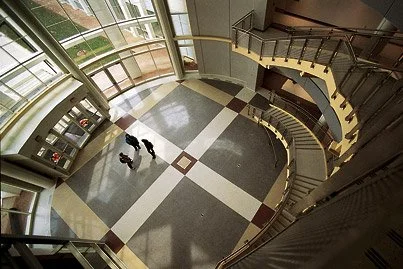
The Rotunda from the The Jeong H. Kim Engineering Building (KEB), viewed from above. The Kim Engineering Building is the main venue of fPET 2026.
fPET 2026
The 2026 Forum on Philosophy, Engineering and Technology (fPET) will be June 9-11, 2026 at the University of Maryland, College Park, in the greater Washington, DC area, USA.
The mission of fPET is to encourage reflection on engineering, engineers, and technology; and to build bridges between existing organizations of philosophers, engineers and scholars in related fields.
KEYNOTE SPEAKERS:
Sabine Ammon (Technical University Berlin)
Zoe Szajnfarber (George Washington University)
Matthew Wisnioski (Virginia Tech)
More information about the keynote speakers is here.
Schedule: fPET 2026 schedule is here (link)and abstract book here (link).
Please see the rest of the site for more information, including how to 'Join the Conversation!, which has a listserv. Questions can be sent to fPET2026@gmail.com.
The fPET 2026 leadership team is listed at bottom of this page. For more on fPET’s history since 2007, go to the fPET community page. Details of the call for abstracts is here.
fPET 2026 Updates
5/14/26: fPET 2026 schedule released (link) and abstract book (link) now online!
5/11/26: New writeup on why Zach thinks you should get excited about the keynote speakers!
3/19/23: REGISTRATION IS NOW OPEN! The registration link will soon be distributed via email, and is also listed in the “Registration & Travel” section below. NOTE: Speakers and attendees who plan to lodge in a dorm must register by April 15th!
3/9/26: Abstract acceptances sent. Registration and hotel block information forthcoming - now estimated to be shared on 3/23.
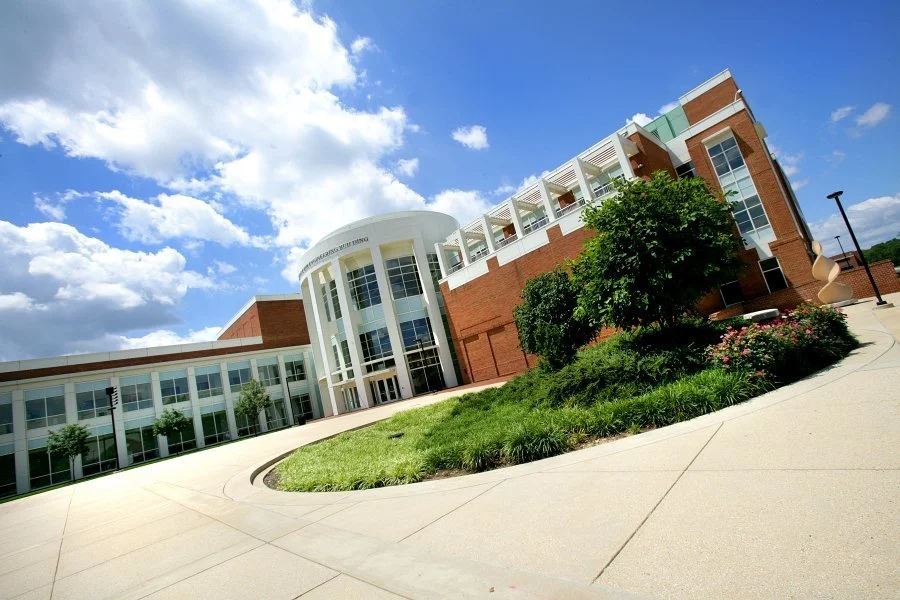
The Jeong H. Kim Engineering Building (KEB), our main venue for fPET 2026.
Event Information
Location & Timing
Dates: June 9-11 of 2026
Location: University of Maryland, College Park (UMCP), which is located just outside of Washington, DC.
Venues: Jeong H. Kim Engineering Building (KEB) and A. James Clark Hall (AJC)
Event Details
The formal fPET conference will begin in 10am eastern on Tuesday, June 9th, and will end at 3pm eastern on Thursday, June 11th.
On the evening of Tuesday, June 9th, we will travel to The Hall CP for a Happy Hour and gathering time. Food and Drink tickets will be provided to registrants.
fPET 2026 thanks The Consortium for Science, Policy & Outcomes in D.C. for its generous sponsorship of the Tuesday night Happy Hour!
On the evening of Wednesday, June 10th, our Keynote Reception & Banquet will be held in AJC. Dinner will be provided to registrants. Please advise of any food allergies or dietary restrictions with your registration.
Dining Options
Lunch will be provided on all 3 days of the conference.
Snacks/refreshments will be provided on all 3 days of the conference.
Dinner will be provided on Wednesday, June 10th.
You are invited to explore the College Park food scene!
Dining options in College Park can be found here; local restaurants are sorted exhaustively by location, and selectively by type.
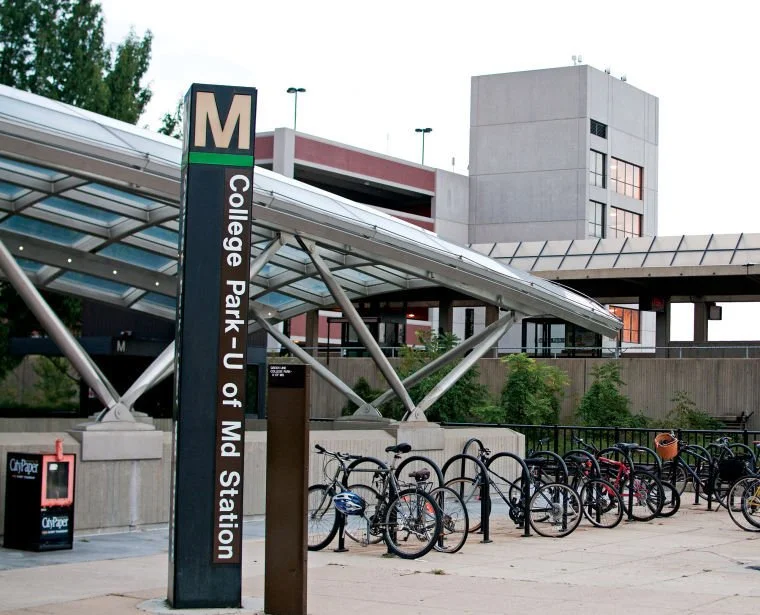
College Park Metro Station, connecting UMCP to Washington, D.C. and the greater DMV via rail.
Registration & Travel
Registration
REGISTRATION LINK: go.umd.edu/fpet2026registration
Registration will remain open until 11:59 PM EST on Sunday, May 31st, 2026.
Speaker Registration Deadline: Wednesday, April 15th, 2026 at 11:59 PM EST.
If possible, we ask that speakers register by April 15th given the number of speakers and our efforts to plan speaking timeslots.
Dorm Room Registration Deadline: -EXTENDED- Thursday, May 21st, 2026 at 11:59 PM EST.
Dorm booking is available through the provided registration portal.
In-Person Attendance Registration Deadline: Sunday, May 31st, 2026 at 11:59 PM EST.
All in-person registrants MUST register by May 31st to be guaranteed provided meals. For in-person registrants who miss this deadline, on-site registration will be available on Tuesday, June 9th from 9AM-5PM in KEB only. Food will not be guaranteed for on-site registrants.
Registration fees are $225.
Cancellation Deadline: Up until 11:59 PM EST on May 31st, 2026, registration is fully refundable less a processing fee of $15.00. No refunds will be provided for cancellations after May 31st.
Travel Tips
CAR:
To park on UMCP campus, please review our Visitor Parking resource page.
We recommend parking your vehicle at:
Regents Garage (metered spots)
The Hotel at UMD (billed to the payment method used for your room)
AIR:
The conference will be accessible from several airports near the Washington, DC area:
Ronald Reagan Washington National Airport (DCA)
Upon arrival, take the Yellow Line Metro train towards Greenbelt and disembark at College Park ($6.70, ~40 minutes).
Take the 104 Shuttle up to campus (Summer Schedule TBD).
Baltimore/Washington International Thurgood Marshall Airport (BWI)
Upon arrival, take the MARC/Amtrak train to the DC area (fare varies, ~40 minutes).
Then, take the Metro train to College Park (fare varies, time varies).
Take the 104 Shuttle up to campus.
Dulles International Airport (IAD)
Upon arrival, take the Silver Line Metro train towards Largo.
Transfer at L'Enfant Plaza to the Yellow/Green Line towards Greenbelt, and disembark at College Park ($6.75, ~1.5 hours).
Take the 104 Shuttle up to campus.
RAIL:
Trains from elsewhere on the Eastern seaboard can go to the DC area. The nearest Amtrak station is Union Station D.C., which is accessible from College Park by Metro train and shuttle.
BUS (SHUTTLE-UM 104):
After arriving on the Metro at College Park Station, come out the East Exit (Campus Drive) and look for UM Bus Shelter.
Take the 104 Shuttle to the University of Maryland Campus.
FOR THE CONFERENCE VENUE: Disembark at the A.V. Williams Building.
FOR THE HOTEL: Disembark at Baltimore Avenue and Campus Drive.
Shuttle-UM is free to ride. Live schedule and updates are viewable via digital signage at the College Park Metro station.
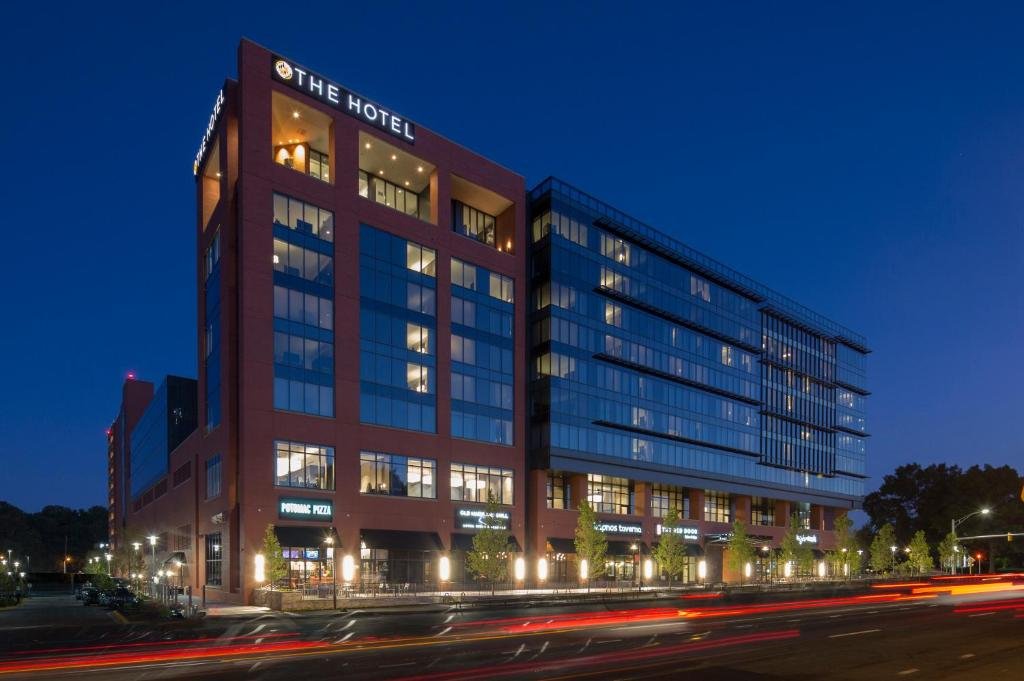
The Hotel at The University of Maryland, photographed at night.
Lodging
Hotels
A group rate is available at The Hotel at UMD, which is a short walk from the venue at the UMD Clark school. The rate of $209 per night can be obtained through our room block link: https://reservations.travelclick.com/107316?groupID=5149378
You are welcome to lodge in any of the other hotels in the area as well.
Dorms
For graduate students and those in need of affordable housing, dormitories at UMD are available. The rate of $100 per night (per person in a double-occupancy room) can be obtained through the registration form, linked above.
You must register and request housing by Wednesday, April 15th in order to secure your room.
Dorm stay is from Monday (6/8) afternoon through Thursday (6/11) morning. In other words, the total fee for a 3 night stay in the dorms is $300.
If you intend to lodge in the dorms and are in need of special accommodations, please contact fPET2026@gmail.com.

A liquid hydrogen tank for use in deep space exploration (NASA).
Thank You to the fPET26 Conference Committees!
fPET 2026 Conference Co-Chairs: Zachary G. Pirtle (Arizona State University), Guru Madhavan and David Tomblin (University of Maryland).
Program Co-Chairs: Rider Foley (Univ. Virginia); Daria Jadreškic (University of Innsbruck); Nicole F. Mogul (UMCP); Tonatuih Rodriguez-Nikl (Cal State LA); Bono Shih (Penn State)
fPET 2026 Program Committee: Kirk Besmer (Gonzaga); Katherine Brichacek (University of Southern California); Rockwell F. Clancy (Virginia Tech); Juan Duran (TU Delft); Rémi Gandoin (C2Wind); Dennis Gedge (Consulting Engineer); Caitlin Grady (George Washington University); Matthew Harsh (Cal Poly); Wybo Houkes (Eindhoven University of Technology); Daria Jadreškić (University of Innsbruck); Vivek Kant (IIT Kanpur); Diane Michelfelder (Macalester College); Nicole Mogul (University of Maryland); Nicole Pettingill (Independent); Michael Poznic (Karlsruhe Institute of Technology); Niharika Pujari (McGraw Hill LLC); Tonatiuh Rodriguez-Nikl (Cal State LA); Andrés Santa-María (Univ. Técnica Federico Santa María); Viola Schiaffonati (Politecnico di Milano); Ashley Shew (Virginia Tech); Bono Shih (Penn State University); Tiffany Smith (Virginia Tech/NASA); Martin Stacey (De Monfort University); Florence Tan (retired NASA); David Tomblin (University of Maryland, College Park); Pieter Vermaas (TU Delft); Gregg Pascal Zachary (retired ASU)
Overall fPET Steering Committee: Co-chair: Viola Schiaffonati (Politecnico di Milano); Co-chair: Zachary G. Pirtle (Arizona State University); Sabine Ammon (TU Berlin); Neelke Doorn (TU Delft); Richard Evans (Cornell University); Albrecht Fritzsche (IEDC - Bled School of Management); David E. Goldberg (ThreeJoy Associates, Inc.); Rafaela Hillerbrand (Karlsruhe Institute of Technology); Guru Madhavan (NAE); Natasha McCarthy (Royal Society); Diane Michelfelder (Macalester College); Carl Mitcham (Colorado School of Mines); Byron Newberry (Baylor University); Joe Pitt (Virginia Tech); Michael Poznic (Karlsruhe Institute of Technology); Ibo van de Poel (TU Delft); Andrés Santa-María (Universidad Técnica Federico Santa María); Ashley Shew (Virginia Tech)
fPET 2026 is hosted by David Tomblin, Director, and Christina Yang, Administrative Coordinator, of the Science, Technology and Society Programs in the A. James Clark School of Engineering, University of Maryland, College Park. The STS work at University of Maryland makes it an exciting venue to host fPET, as they’ve already been active in bringing engineers and social scientists together. More info here.